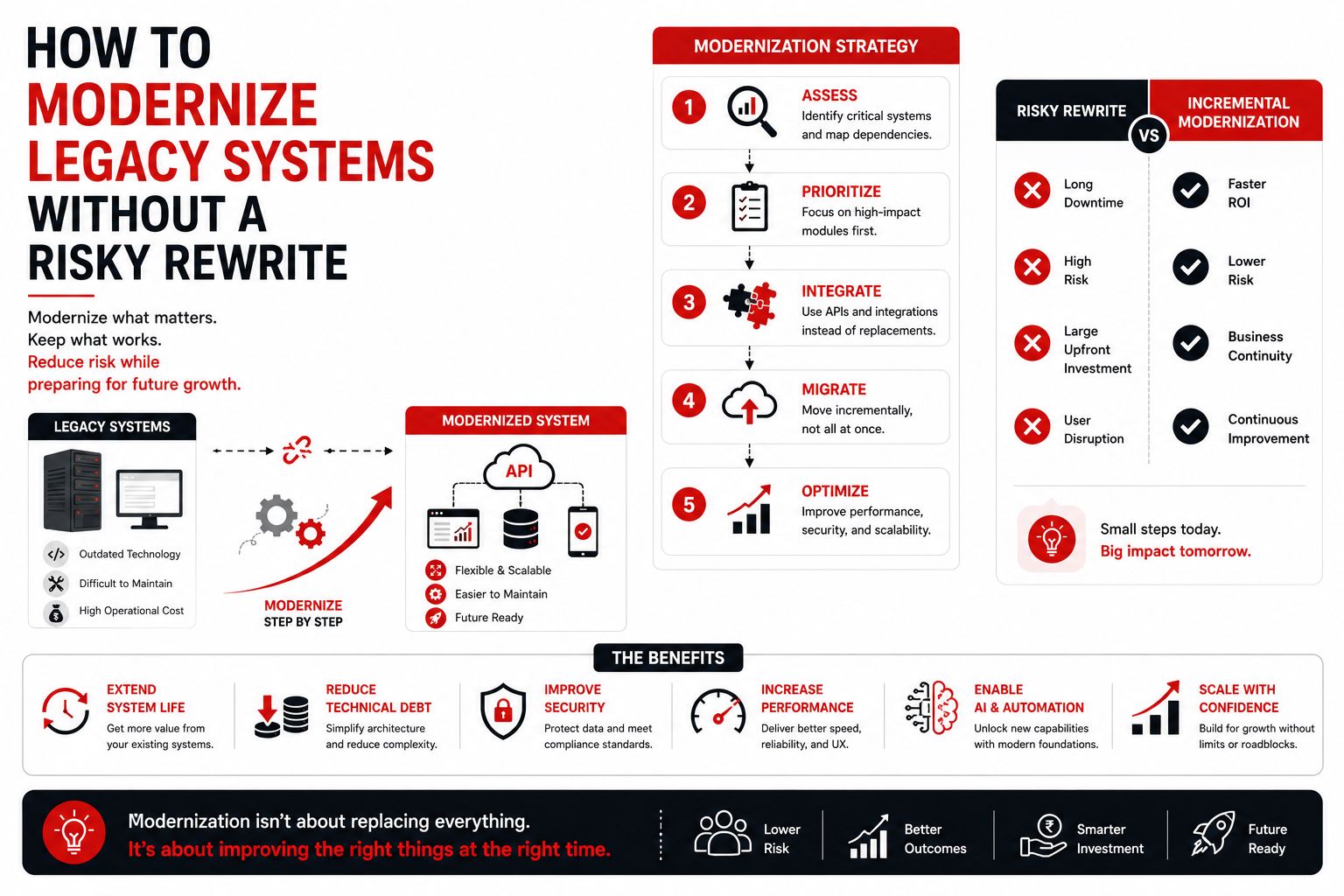
How to Modernize Legacy Systems Without a Risky Rewrite
Every company that has been around long enough has legacy systems. They are the applications that run critical business operations but were built with technology that is now outdated, difficult to maintain, and nearly impossible to extend. The instinct is often to rewrite them from scratch — but full rewrites are among the riskiest endeavors in software.
The good news: you do not need to rewrite everything to modernize. There are proven strategies for incrementally transforming legacy systems while keeping the business running.
Why Full Rewrites Usually Fail
The fundamental problem with a full rewrite is that you are trying to replicate years — sometimes decades — of business logic, edge cases, and accumulated knowledge while simultaneously switching to a new technology stack. Meanwhile, the old system continues to evolve because the business does not stop. You end up chasing a moving target, and the rewrite timeline extends indefinitely.
This is not a theoretical concern. Studies of large-scale software rewrites consistently show that the majority either fail to launch or launch so late that the cost savings never materialize.
The Strangler Fig Pattern: Modernize Incrementally
Named after the tropical fig trees that gradually envelop their host, the Strangler Fig pattern is the most reliable approach to legacy modernization. The idea is simple: instead of replacing the entire system at once, you replace it piece by piece. Over time, the new system "strangles" the old one until the legacy code can be safely decommissioned.
Here is how it works in practice:
- Identify a bounded context: Find a piece of functionality that is relatively self-contained — a reporting module, a user management system, or a specific workflow. This becomes your first migration target.
- Build the replacement in parallel: Develop the new version of this module using modern technology, connected to the same data sources as the legacy module.
- Route traffic gradually: Use a reverse proxy or API gateway to send a small percentage of traffic to the new module while the legacy system still serves the rest. Monitor closely.
- Cut over when proven: Once the new module handles traffic reliably and produces correct results, switch all traffic for that module to the new system. Decommission the corresponding legacy code.
- Repeat: Move to the next bounded context and repeat the process.
Starting With an API Layer
One of the most effective modernization strategies is to wrap your legacy system behind a modern API layer before touching any internal logic. This gives you immediate benefits:
- Modern frontends can consume the API: Build new user interfaces (React, mobile apps, dashboards) that talk to the API layer, which in turn communicates with the legacy backend. The legacy system becomes a data source, not a user-facing application.
- Integration becomes easier: Other systems in your organization can interact with the legacy system through standard REST or GraphQL APIs instead of direct database access or file-based integration.
- You create a clear boundary: The API layer defines a contract between the old and the new. Once that contract is stable, you can replace the legacy implementation behind it without affecting consumers.
Database Modernization Without Downtime
Legacy databases are often the hardest part to modernize because they contain years of business data and are tightly coupled to the application logic. The approach:
- Dual writes: When data changes, write to both the old and new database. This keeps them in sync during the transition.
- Backfill historically: Migrate historical data to the new database. Run validation to ensure consistency.
- Read from new, fall back to old: Configure your application to read from the new database first. If data is not yet migrated, fall back to the old database. This avoids any read-related downtime.
- Cut over writes: Once reads are fully migrated and validated, switch all writes to the new database. The old database becomes read-only, then gets decommissioned.
Adding AI and Automation to Legacy Systems
You do not need to fully modernize before adding AI capabilities. A legacy system behind a modern API layer can integrate with AI services today:
- Document processing: Route scanned documents, PDFs, and emails through an AI extraction pipeline that feeds structured data into your legacy system via API.
- Intelligent routing: Use AI to classify support tickets, orders, or inquiries and route them to the right team or workflow within your existing system.
- Predictive analytics: Pull historical data from your legacy database, run it through ML models, and surface predictions and recommendations in a modern dashboard that sits alongside the legacy application.
When a Rewrite Actually Makes Sense
Incremental modernization is not always the answer. A rewrite may be the right call when the legacy system is so tightly coupled that extracting individual modules is impossible, the technology stack is so outdated that finding developers is impractical (think COBOL or ColdFusion), or the system is small enough that a rewrite can be completed in under six months. But these cases are rarer than most teams assume.
The Human Side of Modernization
Technical strategy is necessary but not sufficient. Legacy modernization projects fail more often due to organizational resistance than technical challenges. The people who built and maintain the legacy system have deep knowledge that is critical to the modernization effort. Involve them early, treat their expertise as an asset rather than a liability, and make sure they understand that modernization is not a replacement of their role — it is an upgrade of the tools they work with.
The Bottom Line
Modernizing legacy systems is a marathon, not a sprint. Start with the API layer. Modernize one bounded context at a time. Add AI and automation where they create immediate value. Keep the business running throughout. And most importantly, resist the siren song of the full rewrite — it has sunk more projects than it has saved.
Ready to build software that actually solves problems?
Start a Conversation