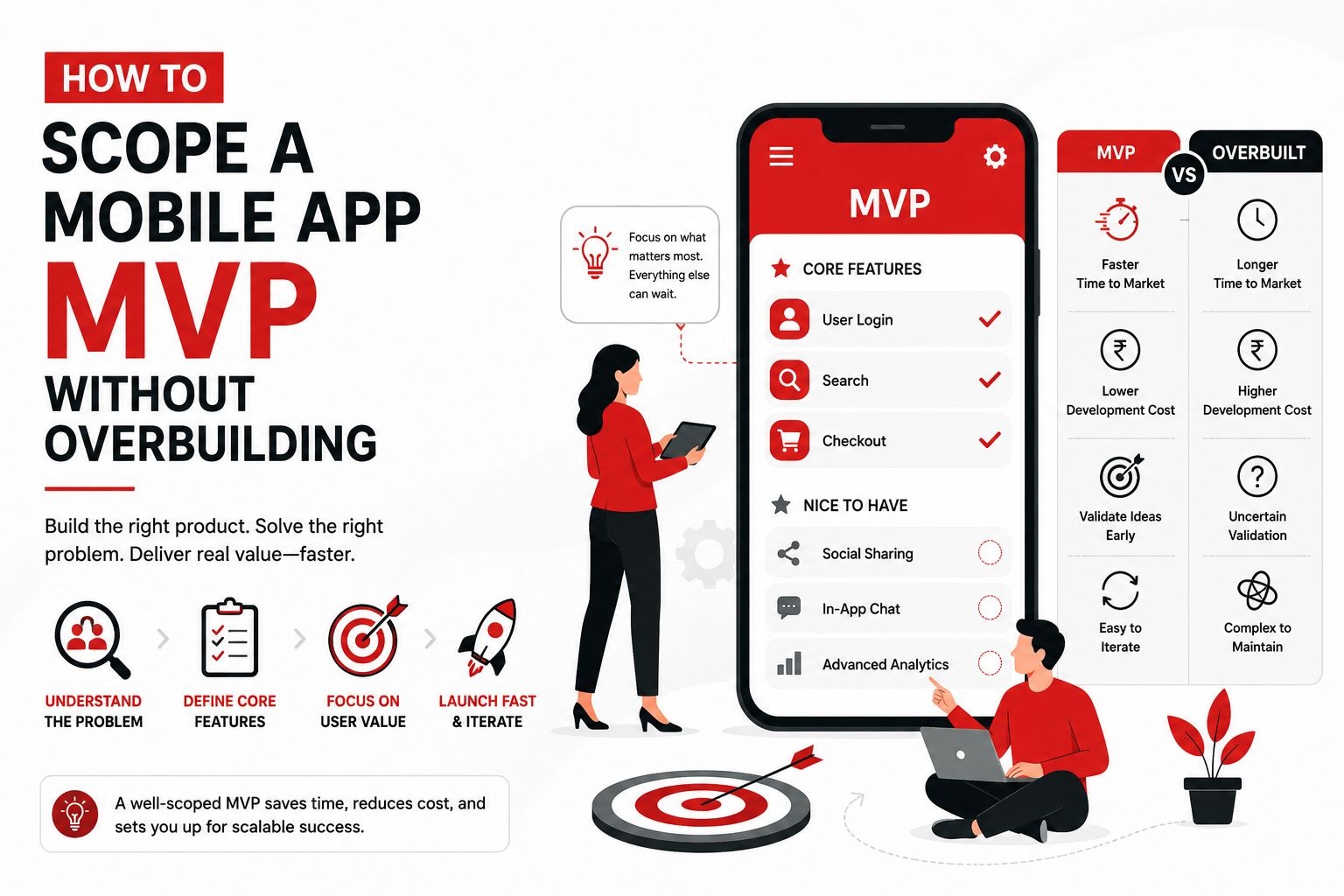
How to Scope a Mobile App MVP Without Overbuilding
Every founder with a mobile app idea faces the same tension: they want to launch quickly, but they also want the product to be impressive enough to attract users. This tension often leads to the single most expensive mistake in mobile development — building too much before you know what actually matters.
An MVP (Minimum Viable Product) is not a stripped-down, inferior version of your vision. It is the smallest possible product that lets you test your riskiest assumptions with real users. The goal is learning, not perfection.
Start With the Core Job-to-Be-Done
Before you think about screens, features, or technology, get specific about the one job your app performs for users. Not ten jobs. One job. If you cannot describe what your app does in a single sentence that a non-technical person understands, you are not ready to build.
For example, Uber's core job-to-be-done was: "Get me a ride from where I am to where I want to go, reliably and quickly." Everything else — fare splitting, scheduled rides, multiple vehicle types — came later, after that core loop was proven.
The Feature Prioritization Framework
When you brainstorm features, categorize them into three buckets:
- Must-have: Without this feature, the core job cannot be completed. The user cannot achieve the primary outcome.
- Should-have: The experience is noticeably worse without it, but the core job still gets done. These are quality-of-life improvements.
- Nice-to-have: These add polish or delight but do not impact whether someone can complete the core task. They belong in version two or later.
Here is the rule most teams break: If it is not in the must-have column, it does not go into version one. No exceptions. Every should-have or nice-to-have feature you add delays your launch, increases your budget, and worst of all — delays the moment you start learning from real users.
Define What You Need to Learn, Not Just What You Need to Build
The most successful MVPs are designed around specific questions. Before you write a single line of code, write down the three questions your MVP must answer:
- Will users actually download and try this?
- Will they come back after the first session?
- What specific behavior tells us they are getting value?
If a feature does not help you answer one of these questions, it does not belong in your MVP. This discipline is hard — it means saying no to ideas that feel important — but it is the difference between shipping in weeks versus months.
Resist the Temptation to Build for Scale on Day One
Many founders worry about whether their architecture will handle thousands of users. But your first problem is getting ten users. Build for the audience you have, not the audience you hope to have. A well-structured React Native or Flutter app with a Firebase or Supabase backend can get you to your first thousand users comfortably. You can refactor for scale when you have proven demand.
Use Off-the-Shelf Wherever Possible
Not everything needs to be custom-built. Authentication, payments, notifications, analytics, and chat all have mature, well-documented solutions. Using Firebase Auth, Stripe, or OneSignal does not make your product less impressive — it frees your development hours for the parts of your product that are genuinely unique.
The Cost of Overbuilding
Every week you spend building features users did not ask for is a week your competitors are learning from real users. Overbuilding does not just waste money — it wastes time, and in software, time is often more expensive than development cost. A lean MVP that ships in 8 weeks and starts gathering feedback is infinitely more valuable than a feature-rich app that launches in 6 months with untested assumptions.
A Practical MVP Scoping Checklist
Before you approve scope for your mobile app MVP, run through this checklist:
- Can I describe the core user job in one sentence?
- Have I identified my top three learning questions?
- Is every feature in the scope tied to either a learning question or the core job?
- Have I removed every should-have and nice-to-have?
- Are authentication, payments, and notifications handled by off-the-shelf services?
- Do I have a plan for measuring what happens after launch?
If you can answer yes to every item, you are ready to build. If not, spend more time scoping before you spend money on development.
Final Thought
The goal of an MVP is not to launch a product that does everything. The goal is to launch the smallest thing that teaches you the most. Good scoping is not about cutting corners — it is about focusing your investment on the 20% of features that drive 80% of the learning. Build less, launch sooner, and let user behavior guide what comes next.
Ready to build software that actually solves problems?
Start a Conversation