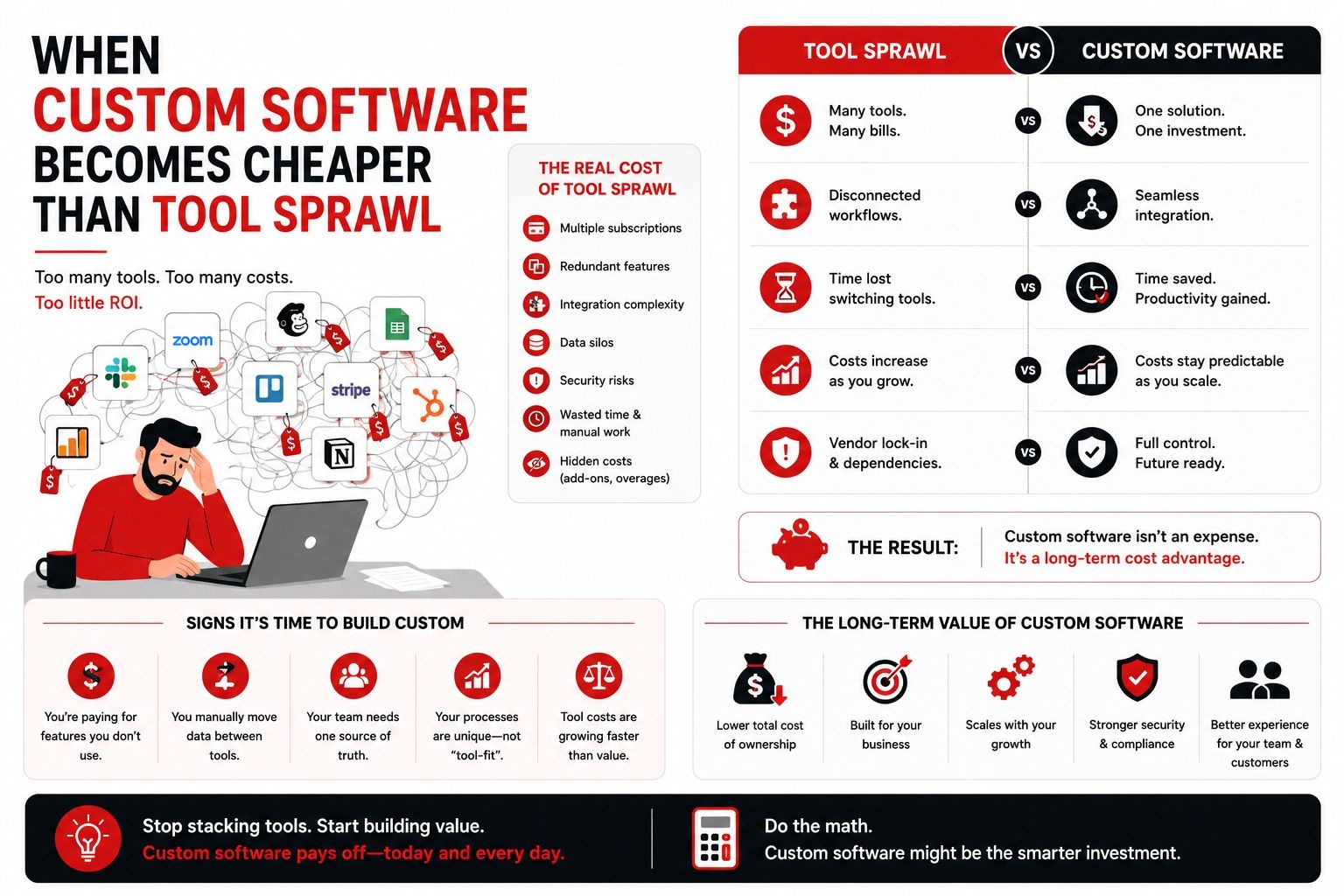
When Custom Software Becomes Cheaper Than Tool Sprawl
Most businesses do not start with a plan to accumulate dozens of disconnected tools. It happens gradually. A spreadsheet here. A SaaS subscription there. A manual workaround that someone built in Zapier. Over time, these tools multiply, and the hidden costs start to compound.
At some point, the cost of managing the chaos exceeds the cost of building a custom system. Knowing when that point arrives — and acting on it — is one of the most impactful decisions a growing business can make.
The Hidden Costs of Tool Sprawl
When businesses rely on a patchwork of tools, the visible cost — subscription fees — is often the smallest part of the problem. The real costs are hidden in operations:
- Manual data transfer: Employees spend hours copying data between systems that do not talk to each other. Every manual transfer is an opportunity for error.
- Inconsistent data: When the same customer, order, or invoice exists in three different systems, which one is correct? Reconciling data becomes a recurring operational burden.
- Training overhead: New hires must learn not one system but a constellation of tools, each with its own interface and quirks. Onboarding takes longer and productivity takes a hit.
- No single source of truth: When leadership asks for a report, someone has to pull data from multiple systems, clean it, and combine it — often manually.
- Vendor lock-in and pricing changes: SaaS tools change their pricing, remove features, or get acquired. Your operations become dependent on decisions made by companies that do not know your business.
The Tipping Point: When Does Custom Software Make Financial Sense?
Custom software has a higher upfront cost than a SaaS subscription. But the math changes when you look at total cost over time. Here is when the equation flips:
- You are paying for five or more SaaS tools to manage what is essentially one business process. The combined annual cost of those subscriptions, plus the employee hours spent connecting them, often exceeds the amortized cost of a custom system within 12–18 months.
- Your team has developed elaborate manual workflows to bridge gaps between tools. If someone built a 12-step process involving three apps and two spreadsheets to accomplish something that should be one click, you have a custom software opportunity.
- Your business process is genuinely unique — not because you chose to make it unique, but because your industry, compliance requirements, or competitive advantage depends on it. No off-the-shelf tool will ever fit perfectly.
- Data errors are causing real damage. Duplicate orders, incorrect inventory counts, or missed customer communications that stem from tool fragmentation have measurable financial consequences.
Calculating the Real ROI
To make an informed decision, calculate the total current cost of your tool ecosystem. Include not just subscription fees but also the estimated employee hours spent on manual data handling, reconciliation, and workarounds. Multiply those hours by fully-loaded hourly rates. Most businesses are surprised by the result.
Then compare that to the cost of a custom system — not just initial development, but ongoing maintenance and hosting. A well-built custom system typically has lower operational costs than maintaining a dozen SaaS integrations, because there are fewer moving parts to break.
The Middle Ground: Build What Is Unique, Buy What Is Commodity
The decision is not all-or-nothing. The most cost-effective approach is often a hybrid: use off-the-shelf tools for commodity functions (email, file storage, authentication, accounting) and build custom software for the workflows that are core to your business. The custom layer becomes the orchestration hub that connects everything else, giving you a single source of truth without reinventing every wheel.
Common Objections (and Why They Are Usually Wrong)
"But SaaS tools update automatically." True — and they also change in ways that break your workflows. A custom system only changes when you want it to.
"Custom software is too expensive." Upfront, yes. Over 3–5 years, a custom system that eliminates 20 hours per week of manual work often pays for itself multiple times over. The key is looking at total cost of ownership, not just the initial build cost.
"We can just add more tools." Every new tool adds integration complexity. The cost of adding the fifth tool is higher than adding the fourth, because each new tool must work with every existing tool. This is a compounding cost problem.
When to Act
The right time to consider custom software is not when your tools stop working — it is when your team spends more time managing tools than doing their actual work. If operational friction is slowing your growth, the cost of inaction may already exceed the cost of building the right system.
Ready to build software that actually solves problems?
Start a Conversation