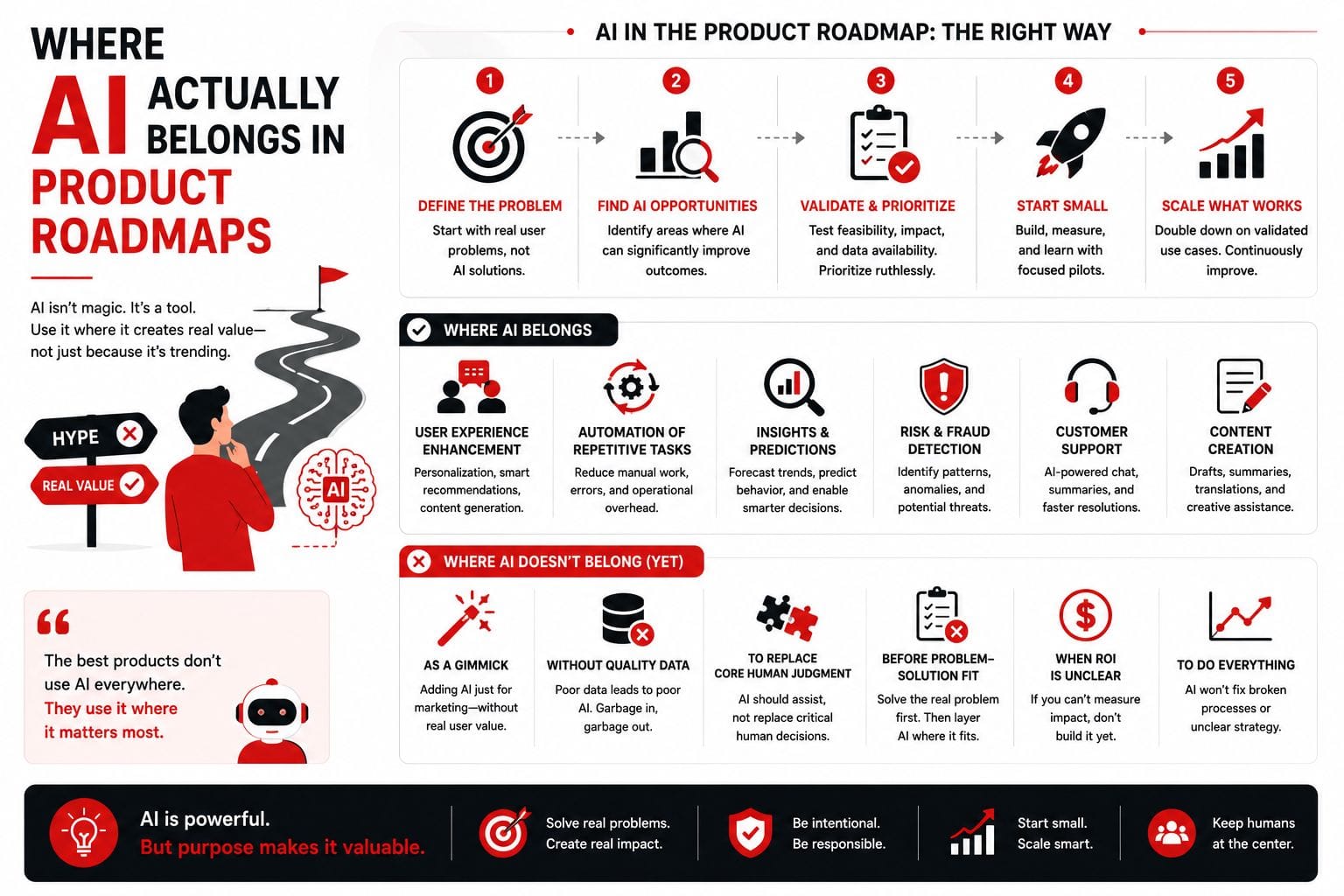
Where AI Actually Belongs in Product Roadmaps
AI is the most hyped technology of the decade, and the pressure to add it to your product is real. Investors ask about it. Competitors advertise it. Customers expect it. But adding AI without a clear purpose is one of the fastest ways to increase complexity, inflate costs, and deliver something users do not actually need.
The question is not "Should we use AI?" The question is "Where does AI actually create measurable value for our users?"
The AI Value Framework: Where AI Excels
AI is genuinely transformative in specific categories. If your product involves any of these, AI deserves a serious place in your roadmap:
- Recommendations and personalization: AI can analyze user behavior to surface relevant content, products, or actions. Netflix recommendations, Amazon product suggestions, and Spotify Discover Weekly are the canonical examples — but the same pattern applies to B2B products recommending relevant reports, workflows, or configurations.
- Smart search and retrieval: Traditional keyword search often fails when users do not know the exact terms. AI-powered semantic search understands intent, making large document repositories, knowledge bases, and product catalogs dramatically more usable.
- Document understanding and extraction: Processing invoices, contracts, resumes, or medical records to extract structured data from unstructured documents is a high-ROI application that directly replaces hours of manual work.
- Intelligent automation: AI can handle the edge cases that rule-based automation cannot — classifying support tickets, routing inquiries, flagging anomalies in transaction data, or suggesting next actions based on context.
- Conversational interfaces: When users need to interact with complex systems through natural language, AI chatbots and assistants reduce the learning curve and improve accessibility.
Where AI Creates More Problems Than It Solves
AI is not a universal solution. There are places where adding it makes your product worse:
- When deterministic logic works fine: If a rules engine or simple algorithm already does the job correctly, replacing it with a probabilistic AI model introduces unpredictability without adding value. Sorting a list alphabetically does not need machine learning.
- When accuracy is non-negotiable: AI models make mistakes. In domains like financial calculations, medical dosing, or legal document generation, even a 2% error rate can be catastrophic. AI can assist humans in these domains, but it should not be the final decision-maker without rigorous oversight.
- When the training data does not exist: AI needs data — lots of it. If your problem domain has limited historical data, or the data is biased or inconsistent, the AI output will reflect those limitations. A bad AI recommendation is worse than no recommendation.
- When user trust depends on explainability: If users need to understand why a decision was made — think loan approvals, insurance claims, or hiring decisions — a black-box AI model may erode trust even if its predictions are accurate.
The Practical AI Integration Playbook
When you do decide AI belongs in your product, follow a structured approach:
- Define the specific user outcome: Not "add AI chat" but "reduce the time it takes a new user to find relevant documentation from 10 minutes to 30 seconds."
- Start with existing APIs before training custom models: OpenAI, Anthropic, Google, and others offer powerful models via API. Unless your use case is highly specialized, building on existing infrastructure dramatically reduces time-to-value.
- Build a human-in-the-loop path: For the first iteration, let AI suggest and let humans confirm. This de-risks the launch, builds user trust, and generates high-quality training data for future iterations.
- Measure baseline metrics before launch: If you cannot quantify how users currently solve the problem, you cannot measure whether AI improved anything. Time-on-task, error rates, and user satisfaction scores should all have baselines.
- Plan for the ongoing cost: API calls are not free, and model quality degrades over time if not monitored. Budget for both compute costs and the human effort required to evaluate and fine-tune models.
AI as a Feature vs. AI as the Product
There is an important distinction between products where AI is the core value proposition and products where AI enhances an existing experience. In the former, AI quality is existential — if the AI does not work, the product has no value. In the latter, the product can succeed even if the AI features are incremental improvements. Be honest about which category your product falls into, because the investment and risk profiles are fundamentally different.
The Bottom Line
AI belongs in your roadmap when it solves a specific, measurable user problem that cannot be solved as well with simpler technology. It does not belong in your roadmap just because it is exciting, because your competitor has it, or because an investor asked about it. Good AI integration starts with a clear problem and a clear success metric. Everything else is just expensive experimentation.
Ready to build software that actually solves problems?
Start a Conversation